
Feature
How to Replace the Right Cruze Key Without Paying for the Wrong Fix
By Dale Corrigan · · 20 min read
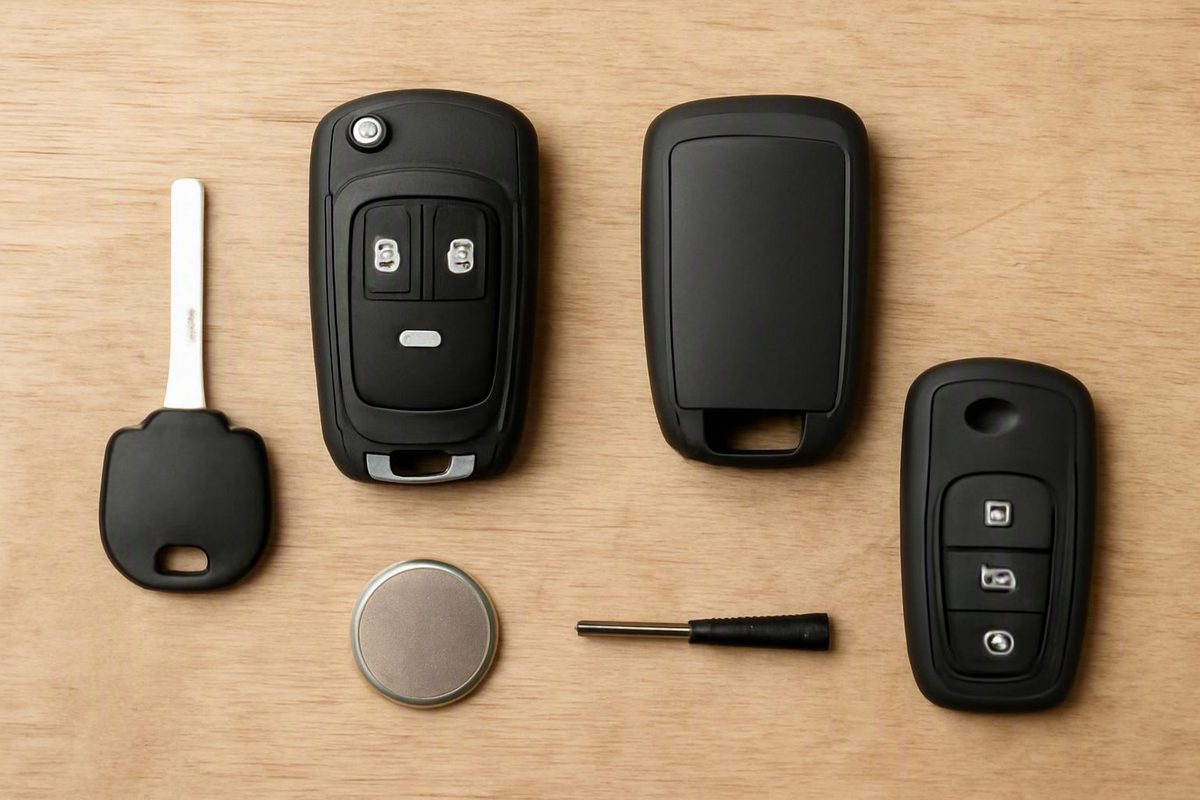
A Chevrolet Cruze key fob replacement is not necessarily a single product purchase. Depending on the failure, the right fix could be a battery, replacement housing, blade repair, complete flip key, transponder key, or proximity transmitter that must be cut and programmed.
The economical approach is to diagnose the failure first, preserve any usable original components, and verify compatibility from the vehicle configuration and identifiers on the existing remote. Only then should you compare the complete cost of hardware, blade cutting, programming, travel, and lost-key security work.
This is a research-based buyer’s guide, not a model-specific programming manual. The available evidence includes commercial catalogs and third-party programming guides but no official Chevrolet owner manuals, GM parts catalogs, or service procedures. Exact programming sequences are therefore intentionally omitted. Confirm consequential fitment, programming, and transmitter-memory work through the owner’s manual for the exact vehicle or a qualified automotive locksmith or Chevrolet dealer.
Start With the Failure: Battery, Shell, Blade, Electronics, or Lost Key?
Begin with the symptoms rather than an online product list.
- Reduced range, intermittent response, or repeated button presses: Check the battery first. These symptoms can indicate a weak battery, but they do not prove that the battery is the only fault. A Chevrolet dealership service page identifies diminished range, intermittent operation, and repeated button presses as possible weak-battery symptoms. Review the dealership’s battery guidance.
- Broken buttons or cracked housing, but the remote still works: Consider a compatible replacement shell.
-
Detached, bent, or damaged blade: Have the blade and flip mechanism assessed. The solution might be a shell, a safely transferred blade, or a newly cut blade.
-
The entire key is missing: Plan for replacement hardware, cutting where applicable, programming, and a discussion about whether the missing transmitter can be removed from vehicle memory.
- You want a spare: Record how many recognized keys remain before choosing a programming route. Some configurations may offer a simpler add-key path while a working key is still available.
The product terms are easy to confuse:
- A battery powers the remote. It does not replace the circuit board, transponder, blade, or housing.
- A transmitter cover is an exterior protector, not a functioning remote.
- A replacement shell is an empty housing. It may include buttons, a hinge, or an uncut blade, but normally depends on components transferred from the original.
- A transponder key contains a security chip that must be recognized before the vehicle can start.
- A flip-key remote combines a folding mechanical blade with remote-control electronics and, where applicable, a transponder.
- A complete smart or proximity key is used by a Keyless Access or push-button-start system. It may also contain a removable emergency blade.
These products are not interchangeable. A low-priced cover or shell does not include the electronics, transponder, cutting, or programming associated with a complete replacement.
Use this triage checklist before ordering:
- [ ] Does the existing key still start the car?
- [ ] Do all remote buttons work?
- [ ] Is operation intermittent or limited to very short range?
- [ ] Is the case, button pad, hinge, or blade attachment broken?
- [ ] Is the blade intact and safely retained?
- [ ] Is the entire fob missing?
- [ ] Does another recognized key or transmitter remain?
- [ ] Has the battery been tested or replaced with the correct type and orientation?
Do not discard a damaged original. Its functioning circuit board, transponder, battery, or cut blade may still be useful. Even if a complete replacement is ultimately required, the original labels and identifiers can help establish fitment.
How to Identify the Correct Chevrolet Cruze Replacement
The reviewed replacement catalogs consistently list Chevrolet Cruze applications for model years 2011 through 2019. One marketplace title extends its claim to 2010, but its captured listing does not provide enough configuration-level information to verify every year and version. Treat a broad year range as a search lead, not proof of compatibility. A specialty catalog covering the 2011–2019 range also warns that visually similar fobs may have different frequencies, capabilities, or keyways. See the catalog’s Cruze range and identification warning.
Model year and appearance are insufficient because similar housings can contain different electronics. Compatibility may depend on:
- FCC ID
- Part number
- Transmitter frequency
- Keyway
- Transponder or security system
- Button layout and supported functions
- Conventional keyed ignition versus Keyless Access or push-button start
- Trim, body style, market, and vehicle variant
Create a compatibility worksheet before contacting a seller or service provider:
| Compatibility field | What to record |
|---|---|
| Model year | The vehicle’s actual model year, not its purchase year |
| Trim | LS, LT, Premier, or the applicable designation |
| Body style | Sedan or hatchback |
| Market | United States, Canada, or another market |
| Catalog category | Cruze, Cruze Limited, Cruze NG, or another listed designation |
| Ignition system | Regular keyed ignition, Keyless Access, or push-button start |
| VIN | Full vehicle identification number |
| Button count | Three, four, or five |
| Button functions | Lock, unlock, panic, trunk or hatch release, remote start |
| FCC ID | Copied exactly from the original transmitter |
| Part number | Every number shown on the original |
| Frequency | If marked or reliably confirmed |
| Keyway | The required blade profile |
| Working keys | Zero, one, or more recognized keys or transmitters |
When the original remote is available, photograph or copy every readable identifier before the label wears away. Compare all identifiers with the listing; do not stop after matching the photograph, case shape, or button count.
If the original is unavailable, give the VIN and complete vehicle configuration to a qualified key seller, automotive locksmith, or Chevrolet dealer. A retailer may offer VIN-assisted identification, but that is a seller service rather than a Chevrolet fitment guarantee. Ask for written confirmation covering the ignition type, body style, market, feature buttons, and exact product supplied.
Catalog labels can conceal meaningful differences. One commercial catalog lists Cruze, Cruze Limited, and Cruze NG separately and asks users to narrow results by year, trim, and options. Review its model-selection structure. Other reviewed catalogs include hatchback-specific products. The evidence does not establish a complete interchangeability chart among these variants, so do not assume that Cruze, Cruze Limited, Cruze NG, sedan, and hatchback keys are interchangeable.
Button count is only one matching field. Catalogs show three-, four-, and five-button configurations, with possible differences involving trunk or hatch release, panic, and remote start. An additional button should not be treated as proof that the replacement electronics match or that the vehicle supports the corresponding feature.
For the same reason, a year-by-year part-number table would create false confidence. Exact fitment can change with vehicle configuration. Verify the individual car and original transmitter instead.
Flip Keys, Smart Keys, Transponder Keys, and Replacement Conditions
Cruze replacement catalogs include several distinct product categories:
- Flip-key remotes
- Smart flip-key remotes
- Proximity or smart-key remotes
- High-security transponder keys
- Standard transmitters
- Empty shells and button housings
- Protective transmitter covers
- Replacement batteries
The appropriate category follows the way the vehicle operates. A conventional ignition key uses a mechanical blade and may contain a transponder that authorizes starting. A push-button-start Cruze uses a proximity transmitter and may include a mechanical emergency blade for door access.
You will also encounter several condition labels:
- OEM new: New original-equipment hardware, which may be sold with or without visible GM branding.
- OEM with GM branding: Original-equipment hardware carrying the applicable branding.
- OEM refurbished: Previously used original-equipment hardware prepared for resale.
None of these labels independently proves reliability or compatibility. Aftermarket hardware may cost less, but the available evidence does not show that aftermarket units are universally equal to—or inferior to—OEM products.
Evaluate each offer using the same questions:
- Do the FCC ID, part number, frequency, keyway, and button functions match?
- Is the unit new, used, or refurbished?
- Does the seller disclose prior use or refurbishment?
- If refurbished, does the seller or programmer guarantee that it is eligible for reuse on this exact configuration?
- What fitment assistance is available?
- Has the seller claimed that the unit was tested?
- What actions make it nonreturnable?
- What warranty covers the hardware?
- Is technical support available?
- Is the blade included?
- Are cutting and programming included?
A retailer’s 2011–2016 Cruze collection illustrates the need to inspect the full offer. It displayed four- and five-button aftermarket flip keys, as well as a high-security transponder key. The five-button example included remote-start and trunk-release buttons, while the four-button version included trunk release. The products were described as fitting only select vehicles, so the collection heading did not prove compatibility with every Cruze in that range. Compare the listed key types and button layouts.
Treat broad marketplace titles with particular caution. One listing advertised a $21.95 aftermarket fob across numerous Chevrolet, Buick, and GMC vehicles and a wide span of years, but the captured information did not identify the main product’s FCC ID, part number, frequency, or detailed Cruze configuration. See the marketplace listing and observed price. A long list of models and years is marketing metadata, not vehicle-specific confirmation.
What Chevrolet Cruze Key Fob Replacement Really Costs
The advertised fob price is only one line in the budget. Ask for a completed-cost quote separating:
- Replacement hardware
- Mechanical blade
- Blade cutting
- Transmitter or immobilizer programming
- Mobile-service or travel charge
- Shipping
- Taxes
- Optional warranty
- Diagnostic charges
- Charges for an unsuccessful programming attempt
- Removal of a lost or stolen transmitter from vehicle memory
- Relearning of retained keys, if required
Retail prices were reviewed on August 5, 2026, and should be rechecked immediately before publication or purchase. They are examples of product differences, not current national installed prices.
One automotive retailer displayed Cruze-related products ranging from a $17.99 transmitter cover to selected smart keys priced at $199.99, while repeatedly directing buyers to verify vehicle-specific fitment. Compare the retailer’s covers, keys, transmitters, and smart-key prices. Those products do not perform the same job: the cover is an accessory, whereas a complete smart key contains working electronics.
Likewise, an empty shell priced near the cost of an inexpensive complete-looking marketplace fob is not necessarily the same purchase. A shell may be the economical repair when the original electronics work, but it cannot replace missing or failed electronics.
Selected retailer listings for 2018 and 2019 Cruze configurations showed starting prices from approximately $34.95 to $73.95, depending on condition and configuration. These were advertised starting prices rather than installed quotes, and the captured catalog did not establish that cutting, programming, shipping, or taxes were included. Review the condition-dependent catalog listings.
For dated, non-Cruze-specific context, Consumer Reports reported in 2019 that replacement fob hardware could cost from $50 to $400, with approximately $50 to $100 more for programming and a mechanical backup key. It also advised checking basic warranty, insurance, roadside assistance, extended coverage, or key-protection benefits before paying. Read the dated cost and coverage discussion. These figures are historical general context, not a current Cruze estimate.
Edmunds also publishes broad ranges that vary according to whether the job involves a basic remote, transponder key, laser-cut blade, switchblade key, or advanced smart fob. Its estimates vary by vehicle, region, parts, and labor and should not replace an itemized local quote. See the key-type cost explanation.
Use this worksheet when comparing providers:
| Cost item | Provider A | Provider B | Provider C |
|---|---|---|---|
| Correct fob or key hardware | |||
| Blade included | |||
| Blade cutting | |||
| Electronic programming | |||
| Mobile travel | |||
| Shipping | |||
| Taxes | |||
| Warranty | |||
| Diagnostic or failed-attempt fee | |||
| Lost-transmitter removal | |||
| Retained-key relearning | |||
| Completed total |
Compare the price of a verified, cut, programmed, working key—not merely the item in the shopping cart.
Can You Program a Cruze Key Fob Yourself?
Determine four facts before looking for a programming method:
- Exact model year
- Regular keyed ignition or push-button/Keyless Access
- Vehicle market
- Number of recognized keys or transmitters still available
Some correctly matched Cruze keys may support an owner learning procedure. Other configurations may require specialized diagnostic equipment. Neither result is universal, and a replacement blade may need to be cut before an applicable learning process can begin.
Third-party guidance for the 2015 Cruze demonstrates how sharply the paths can diverge within one model year. The guide separates regular ignition from push-button ignition, limits its instructions to a specified North American market excluding Canada, and distinguishes between situations with and without a recognized key or transmitter. It says the regular-ignition replacement blade must be cut first and describes an approximately 30-minute push-button procedure when no recognized transmitter remains. It also says that the longer process can erase prior transmitter recognition and recommends maintaining vehicle battery voltage. Review the bounded third-party 2015 guidance.
That commercial guide is not identified as official Chevrolet documentation and does not establish a procedure for another year, market, or equipment package. Its sequence should not be generalized.
A separate third-party guide for 2012–2013 Cruze Keyless Access vehicles requires an existing recognized remote for its owner procedure. It directs owners with no programmed remotes to an automotive locksmith or dealership. It also states that disabling lost remotes may require remaining remotes to be programmed again. Read the limited 2012–2013 Keyless Access guidance.
The available third-party sources conflict about whether all-keys-lost owner relearning is available across configurations and about how many keys or transmitters particular systems can store. Those conflicts may reflect different systems, years, or inaccurate guidance. They should not be resolved into a Cruze-wide rule.
The practical distinctions are:
- Adding a key while a recognized key remains may preserve existing keys on some configurations.
- An all-keys-lost relearn may erase prior recognition on some configurations and may require retained transmitters to be relearned.
Because these outcomes involve vehicle access and security, consult the owner’s manual for the exact year, market, and ignition system before starting. If the manual does not clearly authorize an owner procedure—or if every key is lost—ask a qualified automotive locksmith or Chevrolet dealer to confirm the correct method and its effect on retained keys.
Owner forums may help identify questions to ask about blade transfers or programming eligibility, but forum sequences are not verified Chevrolet procedures and should not be treated as universal tutorials.
When a Replacement Shell Can Save the Original Fob
A shell-only repair is appropriate when the original remote electronics still work but the case, buttons, hinge, or blade attachment is damaged.
In a typical shell swap, the original circuit board, battery, and compatible key components are moved into a new housing. Because the vehicle continues to see the already recognized electronics, no new transmitter is being learned. Programming may therefore be unnecessary.
Consumer Reports documented this approach in 2019 using its 2017 Cruze. It bought a $19.95 aftermarket case, transferred the original internals and battery, and reported that the rebuilt fob worked without reprogramming. See the documented Cruze shell replacement.
That example does not prove that:
- One shell fits every Cruze key
- Every blade can be transferred
- Every circuit board fits a similar-looking housing
- A case can repair failed or missing electronics
- All hinges and retaining-pin designs are identical
- Every shell has the correct button layout
Treat internal dimensions, button alignment, hinge construction, blade dimensions, retaining method, circuit-board fit, and battery space as compatibility questions to verify with the seller or installer. These are general inspection points, not confirmed specifications for every Cruze housing.
Cruze owners have reported transferring blades by removing a retaining or roll pin, but those reports are anecdotal rather than manufacturer disassembly instructions. Review the owner-reported shell discussion. Do not assume that the same method applies to a different housing.
Stop and use a professional if opening the case risks damaging a working circuit board, transponder, battery contact, hinge spring, or blade mechanism. Preserving the recognized electronics is the financial advantage of a shell repair; damaging them can turn a housing problem into a complete replacement.
Online Seller, Automotive Locksmith, or Chevrolet Dealer?
There are four common ways to complete a Chevrolet Cruze key fob replacement.
Buy the hardware online and complete the work yourself
This route can provide lower advertised hardware prices and a broad selection of aftermarket, new OEM, and refurbished OEM products. It works best when:
- You can positively identify the replacement
- The necessary blade-cutting service is available
- The exact owner’s manual confirms an applicable programming process
- You understand the seller’s return restrictions
- You can accept the risk and cost of an unsuccessful attempt
The main disadvantages are fitment risk and divided accountability. One company may sell the hardware, another may cut the blade, and a third may attempt programming. If the key fails, each party may attribute the problem to another provider.
Before ordering, ask whether cutting, opening the package, inserting the battery, or attempting programming changes return eligibility. For used or refurbished hardware, ask whether eligibility for reuse is included in the seller’s fitment or programming guarantee.
Use an automotive locksmith
A qualified automotive locksmith may be able to identify, supply, cut, and program the key in one transaction.
Confirm Cruze-specific capability before booking. Ask whether the locksmith supports the exact model year, market, ignition system, and add-key or all-keys-lost situation. Locksmiths differ in inventory, cutting equipment, software, and access to proximity-key systems.
Book a mobile key service
A mobile provider may complete the work where the vehicle is located, which can be useful when no working key remains. Availability varies, and the quote may include a call-out or travel charge.
Ask whether the advertised amount is only a starting price or the complete charge for hardware, cutting, programming, travel, and taxes. Confirm whether an unsuccessful programming attempt creates an additional fee.
Use a Chevrolet dealer
A Chevrolet dealer provides brand-specific service and VIN-based processes. This can be a cautious route when compatibility is uncertain, every key is missing, or specialized procedures may be required.
A dealer should not automatically be assumed to be either mandatory or cheapest. Consumer Reports quoted an unnamed Chevrolet representative as saying that GM fob programming did not necessarily have to be performed by a dealer and that the applicable procedure would be described in the vehicle owner’s manual. Because that statement is secondhand and not a substitute for official documentation, confirm the process for the exact vehicle.
The vehicle may need to be present for programming, and providers may request identification and proof of ownership before producing a key. One Chevrolet dealership, for example, lists a driver’s license, title or insurance card, registration, and license-plate number among its requirements. Review that dealership’s documentation policy. This is one dealership’s process, not a universal legal or provider requirement.
Use this call script:
I have a [model year] Chevrolet Cruze [trim and body style] from the [market]. It has [regular keyed ignition/Keyless Access/push-button start]. The VIN is [VIN]. The existing remote shows FCC ID [ID], part number [number], and [number] buttons for [functions]. I currently have [zero/one/two] recognized keys. Please quote the complete price for compatible hardware, blade cutting, programming, travel, taxes, warranty, and removal of the missing transmitter from memory if applicable.
Before booking, ask:
- Do you guarantee fitment from the supplied VIN and identifiers?
- Is the quoted part aftermarket, new OEM, or refurbished OEM?
- If used or refurbished, is it eligible for reuse on this vehicle?
- Is a blade included?
- What cutting method is required?
- Are cutting and programming included?
- Must the vehicle be present?
- Must every retained key be present?
- What identification and ownership documents are required?
- What happens if programming fails?
- Is there a diagnostic or failed-attempt fee?
- What warranty covers the hardware and labor?
- Can a missing transmitter be removed from memory?
- Will retained keys need to be relearned?
- What is the final price after travel, taxes, and all services?
Final Pre-Purchase and Lost-Key Security Checklist
Complete this checklist before ordering hardware or authorizing work.
Vehicle and fob identification
- [ ] Model year
- [ ] Trim
- [ ] Sedan or hatchback
- [ ] Country or market
- [ ] Cruze, Cruze Limited, Cruze NG, or another catalog category
- [ ] Regular keyed ignition, Keyless Access, or push-button start
- [ ] VIN
- [ ] FCC ID
- [ ] Part number
- [ ] Frequency
- [ ] Keyway
- [ ] Button count
- [ ] Remote-start button required
- [ ] Trunk or hatch-release button required
- [ ] Number of recognized keys remaining
Product type and condition
- [ ] Battery only
- [ ] Protective cover
- [ ] Empty shell
- [ ] Standalone transmitter
- [ ] Transponder key
- [ ] Flip-key remote
- [ ] Complete proximity key
- [ ] Aftermarket new
- [ ] OEM new
- [ ] OEM refurbished
- [ ] Refurbished unit confirmed eligible for reuse
Blade and cutting
- [ ] Is a blade included?
- [ ] Does it arrive cut or uncut?
- [ ] Does the blade match the required keyway?
- [ ] Can the original blade be transferred safely?
- [ ] What cutting equipment or method is required?
- [ ] Is cutting included in the price?
- [ ] Who is responsible if the cut is incorrect?
Programming
- [ ] Does the exact vehicle’s owner manual authorize an owner procedure?
- [ ] Who will program the transmitter or transponder?
- [ ] Must the vehicle be present?
- [ ] Must every retained key be present?
- [ ] Does the blade need to be cut first?
- [ ] Could the process erase existing key recognition?
- [ ] What happens if programming fails?
- [ ] Is an unsuccessful attempt billable?
Returns and warranty
- [ ] Does cutting make the product nonreturnable?
- [ ] Does opening the package or shell affect returns?
- [ ] Does a programming attempt affect returns?
- [ ] Does the seller guarantee compatibility from the FCC ID, part number, or VIN?
- [ ] Does the seller guarantee that a refurbished transmitter can be reused?
- [ ] What hardware warranty applies?
- [ ] Is programming labor warranted?
Lost-key security
If a key was lost or stolen, tell the provider before programming the replacement. Ask:
- [ ] Can the missing transmitter be removed from vehicle memory?
- [ ] Must every retained key be relearned?
- [ ] Could a key that is not present be disabled?
- [ ] Does the missing mechanical blade create a separate security concern?
- [ ] What is the complete charge for replacement and security work?
There is no supported universal deletion sequence for every Cruze. Third-party guidance indicates that the effects can vary, and an inapplicable relearn may affect retained keys. Have the provider explain the expected result before work begins.
If one operational key remains, consider replacing the missing spare before the last recognized key is lost. Some configurations may provide simpler options while a working key remains.
The recommended order is straightforward:
- Diagnose whether the problem is the battery, shell, blade, electronics, or a missing key.
- Preserve the damaged original and record the vehicle and transmitter identifiers.
- Verify the exact replacement by configuration and identifiers.
- Obtain an itemized completed-cost quote.
- Confirm the programming method and its effect on retained keys.
- Address lost-key security where necessary.
- Only then purchase, open, or cut the replacement.
Chevrolet Cruze Key Fob Replacement FAQs
How much does a Chevrolet Cruze replacement key fob cost?
It depends on whether you need a battery, cover, shell, flip key, transponder key, or complete proximity key. Advertised hardware prices are not installed prices.
Request an itemized quote covering the hardware, blade, cutting, programming, travel, taxes, warranty, failed-attempt charges, and any lost-key security work. Check warranty, insurance, roadside-assistance, extended-coverage, or key-protection benefits before paying, without assuming that coverage is included.
Can I program a Chevrolet Cruze key fob myself if I have one working key?
Possibly, but one recognized key does not guarantee that an owner procedure applies. Eligibility depends on the exact model year, market, ignition system, replacement hardware, and vehicle configuration.
Check the owner’s manual for the exact vehicle. If it does not clearly authorize a procedure, ask a qualified automotive locksmith or Chevrolet dealer whether professional equipment is required and whether all retained keys must be present.
Can I replace only the shell if my Cruze key buttons or case are broken?
Yes, when the original electronics still work and the new housing is physically compatible. Retaining the recognized circuit board may avoid programming because no new transmitter is being introduced.
A shell cannot replace missing electronics or repair a failed circuit board. Verify the board fit, button layout, hinge, blade dimensions, retaining design, and battery space before opening the original.
How do I know which key fob fits my Chevrolet Cruze?
Match more than the model year and case shape. Record the ignition type, VIN, FCC ID, part number, frequency, keyway, button functions, trim, body style, market, vehicle variant, and number of working keys.
If the original remote is missing, provide the complete configuration and VIN to a qualified seller, automotive locksmith, or Chevrolet dealer. Ask for written fitment confirmation before the key is cut or becomes nonreturnable.
What should I do if every Chevrolet Cruze key or remote is lost?
Do not order solely by year or appearance. Record the VIN, model year, trim, body style, market, and ignition type, then contact an automotive locksmith or Chevrolet dealer with confirmed capability for that configuration.
Request a completed quote covering hardware, blade cutting, programming, mobile travel or towing implications, taxes, and removal of missing transmitters from memory where supported. Bring the identification and proof-of-ownership documents requested by the provider.
Do not assume that an online all-keys-lost procedure applies. The available third-party guidance conflicts across configurations, and some relearns may affect prior transmitter recognition. Confirm the applicable process and security consequences before work begins.